
First, let me confess: the first time I saw a smart bulb I thought, “Do I really want my lightbulb gossiping with Alexa all day?” But after living with a few in my home, I realized the real question isn’t whether smart lights are flashy—it’s whether they’re actually better than the dependable, no-fuss LED bulbs most of us already use.
If you’ve ever stood in the lighting aisle holding a $2 LED next to a $20 smart bulb and wondered which one is worth your hard-earned cash, this is your guide. We’ll dig into costs (short and long term), energy usage, scenarios where smart bulbs shine, and cases where regular LEDs still pull ahead.
Here’s what we’ll cover:
-
Cost breakdown: Upfront vs. Lifetime Cost
-
Energy efficiency: Who wins when the bill arrives
-
Where smart bulbs truly shine (pun intended)
-
When regular LEDs are still the smarter buy
-
Mixing & matching smart + regular in your home
-
Maintenance, pitfalls & tips
-
Final verdict and recommendations
Let’s get started.
1. Cost Breakdown: Upfront vs. Lifetime Cost
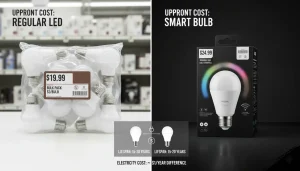
Upfront Price Shock
Regular LED bulbs are in the “impulse buy” zone. You’ll find perfectly serviceable ones for $2 to $5 each (or even less in bulk).
Smart bulbs, meanwhile, tend to start around $10 to $20 for a basic one. Premium ones—like Hue, LIFX, Nanoleaf—can stretch beyond $30 to $40, especially when a hub or bridge is involved.
So yes: upgrading your whole house to smart bulbs at once can feel like ordering full-course dinner at a fancy restaurant when all you need is toast.
Lifespan & Replacement Cost
Here’s where things even out a little:
-
Most LEDs (smart or not) last 15,000 to 25,000 hours. If you use a bulb ~3 hours per day, that’s 10 to 20 years of lighting.
-
The marginal extra electronics in smart bulbs may slightly reduce that lifespan, but not dramatically for most good brands.
Because both types last long, the replacement cost over a decade becomes small relative to electricity usage (and features).
Electricity Use: The Real Long-Term Cost
A standard LED might consume ~9 watts to deliver ~800 lumens (approximate brightness of a 60W incandescent). A smart bulb might use 9–11 watts, accounting for the extra electronics and connectivity.
That difference—2 watts on a bulb you use hours a day—is minimal. Over a year, you might pay a few extra cents. The real energy savings come from how smart bulbs let you control when and how long lights are on (more on that soon).
So in most homes, the extra wattage of the smart bulb is negligible compared to the benefits of automation.
Bottom line on cost: If you want bare-minimum light, regular LEDs are cheap and powerful. But if you value control, atmosphere, and convenience, smart bulbs can justify their higher price—especially when used selectively.
2. Energy Efficiency: Smart Bulbs vs. Regular LEDs
Let’s talk efficiency—not in vague marketing terms, but in how much light per watt, and how features influence real consumption.
Luminous Output vs. Wattage
-
Regular LED: ~800 lumens at ~9W
-
Smart LED: ~800 lumens at ~9–11W
In pure efficiency terms, regular LEDs have a slight edge. But because the difference is so small, it rarely shows up as a major bump in the monthly bill.
Where Smart Bulbs Save Real Energy
Smart lights don’t save power by magic—they save it by being smarter about when and how they’re on. Here’s how they quietly cut down your bill:
-
Scheduling: Turn off lights when no one’s home (yes, your living room can stop trying to light itself).
-
Motion sensor/occupancy triggers: Lights can go off automatically in empty rooms.
-
Dimming / adaptive brightness: Dimming to 50% uses less wattage while still lighting the room.
-
Smart scenes: Combining lights into zones that dim/brighten based on time, day, or triggers.
In other words, the bulb itself isn’t magically more efficient, but your usage becomes smarter. Over months and years, that adds up—especially in households where lights sometimes stay on by accident.
3. Situations Where Smart Bulbs Shine
Smart bulbs aren’t just gimmicks. They bring real, tangible advantages in the right contexts. Based on my experience (and that of many smart-home enthusiasts), here are where they really make sense:
Mood Lighting & Ambiance
Want a calm, soft glow at 9 pm, crisp daylight-white for morning, or warm amber for movie night? Smart RGB or color-temperature-tunable bulbs let you sculpt atmosphere. Regular LEDs—even dimmable ones—can’t match that flexibility.
Smart Home Integration
If you already have Alexa, Google Home, Siri (HomeKit), or other home automation, smart bulbs plug in seamlessly. Saying “Hey Alexa, lights off” from bed is a small luxury you don’t realize you’ll love—until you’ve had it.
Automation & Scheduling
Lights that know when they should be off (when you leave), or when to adjust (sunset, sunrise, bedtime) reduce waste and improve comfort.
Remote Control & Monitoring
Even when you’re away, many smart bulbs let you control them over your phone. Forgot a light on downstairs? Turn it off while lying in bed across town. Neat!
No Rewiring, Just Screw-In Upgrade
If you don’t want to tinker with switches or wiring, smart bulbs give you dimming, scheduling and control without installing special dimmer switches or rewiring.
Edge Cases: Color Effects & Sync
Want your lights to flicker like a fireplace, pulse with your music, or shift color with your screen? Some smart bulbs (especially in gaming/ambiance setups) do that. Regular LEDs just sit there, blinking with jealousy.
4. When Regular LEDs Still Win
Smart bulbs are cool, but they’re not always the smartest purchase. Here are times regular LEDs still make more sense:
Budget Is Tight
If you’re replacing many bulbs—say in a large house—regular LEDs are far more economical. Even a midrange smart bulb might cost as much as 5–10 regular ones. When you’re just trying to get light at a minimal cost, the simpler route often wins.
You Don’t Care About Features
If you’re perfectly content flipping a switch and having a stable white light, there’s no point paying extra. If you don’t use—or plan to use—apps, color, dimming, or schedules, regular LEDs do the job reliably.
You Use Smart Switches Already
In many cases, you can retrofit a smart wall switch or smart dimmer to control multiple lights at once. That often yields more bang per dollar than replacing every bulb with a smart one (especially in multi-bulb fixtures).
Network Dependence & Reliability
Smart bulbs depend on Wi-Fi, Bluetooth, or Zigbee. If your network is spotty, they may lag or lose connection. A regular LED doesn’t care about routers or firmware updates—it just shines.
Maximum Uptime & Stability
In critical areas like closets, stairwells, or hallways, a standard LED bulb ensures instant lighting with no app delay or connectivity issues. If you need always-on, reliable illumination, regular LEDs are a dependable choice.
5. Mixing Smart + Regular in Your Home
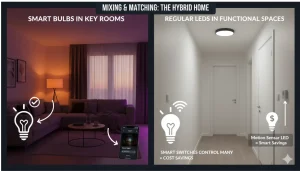
You don’t need to pick sides. The real pros mix and match. Here’s a balanced strategy:
-
Use smart bulbs in key rooms: living room, bedroom, media spaces, and entryway.
-
Stick with regular LEDs in closets, hallways, utility rooms, and spaces where you rarely need fancy features.
-
If a fixture has multiple bulbs, maybe only one is smart—so even if the system hiccups, you retain basic light.
-
Use smart switches/dimmers for groups of lights and keep regular bulbs behind them.
-
Add motion sensors and smart plugs in conjunction with lights to offload some of the “smarts” without converting every bulb.
This balance often gives you the perks of smart lighting without blowing your budget.
6. Maintenance, Pitfalls & Common Mistakes
Smart or regular, bulbs require care. But smart bulbs bring extra dimensions of complexity. Here are things that go wrong (and how to avoid them):
Firmware, Connectivity & Updates
-
Smart bulbs run on software. Occasional firmware updates can break compatibility or require resets.
-
Using bulbs from too many brands (Alexa, Zigbee, Wi-Fi) can complicate your smart-home ecosystem. Stick with a family of bulbs you trust.
-
Weak Wi-Fi (especially at the extremities of your home) can cause dropped signals, delays, or “bulb not responding” errors.
Filter & Cleanliness (for regular LEDs, less relevant)
While regular LEDs are simpler, smart bulbs sometimes come with cooling vents or sensitive internal electronics—keep them dust-free so they don’t overheat or misbehave.
Overuse & Wear
Using color/animation scenes often (fading, flashing) may stress the electronics slightly more than static white light. Not enough to make them useless, but something to note.
Power Surges & Reset Risks
If your power is unstable, smart bulbs might reset or get confused—especially cheaper models without surge protection.
Proper Placement & Interference
-
Don’t place smart bulbs behind deep shades or bulbs that block line-of-sight to your hub/router.
-
Avoid putting them near heavy RF interference (wireless routers, microwaves) that can disrupt signals.
Compatibility & Hub Requirements
Some smart bulbs need a central hub (Hue Bridge, etc.). Make sure your system supports the bulbs you choose (Wi-Fi, Zigbee, Z-Wave). A bulb that “works” but lacks full functionality due to a missing hub can feel frustrating.
Retaining Manual Control
If someone flips a physical switch off, the bulb loses power and the “smart” features can’t activate until it’s switched back on. Some folks use “smart switches that are always on” or disable wall switches.
7. Final Verdict & Smart Buying Recommendations
Let me sum it all up the way I’d tell a friend over coffee:
-
If you just want solid, cheap, reliable lighting—regular LEDs still deliver.
-
If you value flexibility, mood lighting, automation, or connectivity, smart bulbs are worth the extra investment, especially in key rooms.
-
You don’t have to “go all in.” A hybrid approach often gets you 90% of the benefits at a fraction of the cost.
-
Over time, the extra cost of a smart bulb is often offset by reduced waste (lights left on) and an upgraded living experience.
If I were installing lighting in my own home again today, here’s what I’d do:
-
Pick one or two rooms where lighting ambience matters most (living room, bedroom). Put smart bulbs there.
-
Use regular LEDs for secondary and functional spaces (closets, halls, bathrooms).
-
Use a smart switch or motion sensor to control groups of lights.
-
Choose a bulb ecosystem (Hue, LIFX, etc.) and stick with it for ease of integration.
-
Don’t replace everything at once—try a few and see how much you actually use the “smart” functions.