
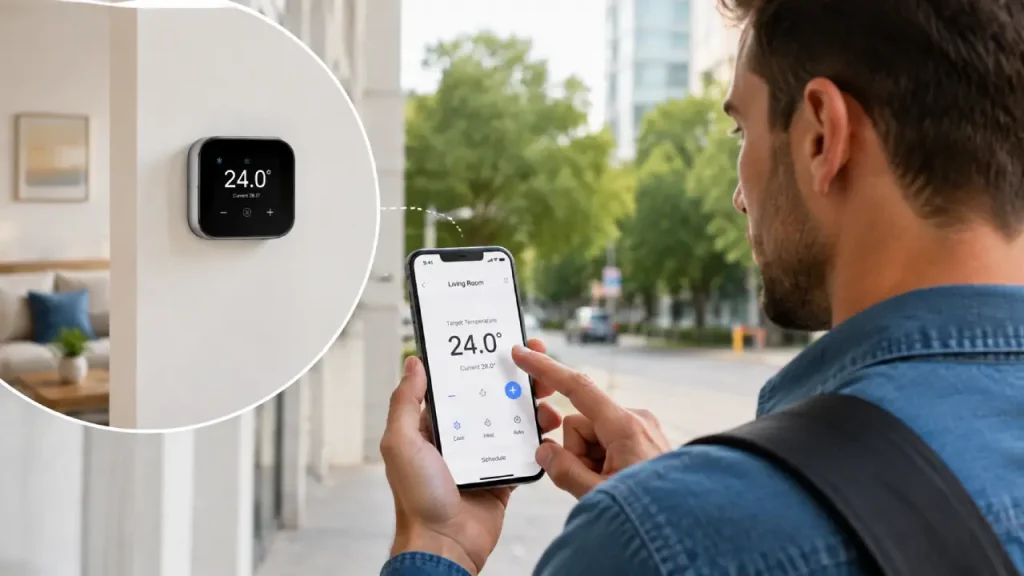
Keeping your home comfortable does not always mean using more energy. In fact, the right thermostat can help you maintain a pleasant temperature while avoiding unnecessary heating and cooling. A smart thermostat for energy saving uses connected technology, scheduling, sensors, and automation to manage your home’s temperature more efficiently. Instead of running your heating or cooling system at the same level all day, it can adjust settings based on your routine and preferences.
Moreover, smart thermostats give homeowners more control over how and when their HVAC systems operate. You can change settings from your phone, create schedules, and sometimes receive insights about your energy use. Therefore, understanding how these devices work can help you decide whether one makes sense for your home.
What Makes a Thermostat Smart?
A traditional thermostat mainly lets you choose a temperature and turn your heating or cooling system on or off. A smart thermostat goes several steps further.
Most smart models connect to your home Wi-Fi network. As a result, you can often control them through a smartphone app instead of relying only on the wall-mounted device. Depending on the model, you may also get features such as:
- Custom temperature schedules
- Remote temperature control
- Occupancy or motion sensing
- Learning features
- Energy-use reports
- Maintenance reminders
- Smart home integration
- Automatic temperature adjustments
However, not every smart thermostat offers the same features. Some models focus mainly on scheduling, while others use sensors and algorithms to adapt to your household routine.
For example, imagine that your family normally leaves home at 8 a.m. and returns at 6 p.m. A compatible thermostat may reduce heating or cooling during those empty hours. Then, it can bring the temperature closer to your preferred setting before everyone returns.
This approach matters because your HVAC system does not need to maintain the same indoor temperature when nobody is home.
How a Smart Thermostat for Energy Saving Works
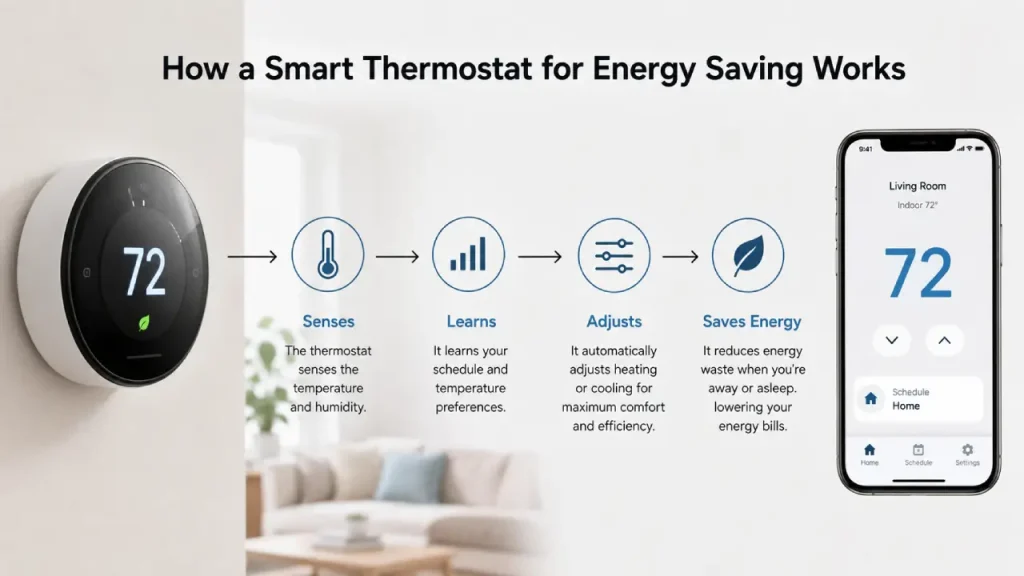
The basic idea is simple: use your HVAC system when you need it and reduce unnecessary operation when you do not.
A smart thermostat can achieve this in several ways. First, scheduling lets you decide when your home should be warmer or cooler. Second, sensors can help identify whether people are actually using certain spaces. Third, some systems can learn patterns and make automatic adjustments.
For instance, you might set a slightly higher cooling temperature while everyone is asleep. During the day, the thermostat can follow another setting. When you leave for work, it may switch to an away temperature. Later, it can return to a more comfortable setting before you arrive.
Additionally, smartphone access gives you another layer of control. If you forget to change the temperature before leaving home, you may be able to adjust it remotely.
That does not mean every smart thermostat will automatically reduce your energy bill. Your results depend on your climate, HVAC system, home insulation, temperature preferences, household routine, and thermostat settings. Nevertheless, better control can help reduce unnecessary heating and cooling.
Why Temperature Scheduling Matters
One of the easiest ways to waste energy is to heat or cool an empty house as if someone were home.
Temperature scheduling addresses this problem. Instead of keeping one setting throughout the entire day, you can create different temperature targets for different periods.
A basic schedule might look like this:
| Time | Home Activity | Example Setting |
|---|---|---|
| Morning | Getting ready | Comfortable |
| Daytime | Home is empty | Energy-conscious |
| Evening | Family is home | Comfortable |
| Night | Sleeping | Slightly adjusted |
The exact temperature depends on your comfort level, climate, HVAC equipment, and household needs. Therefore, there is no single temperature setting that works perfectly for every home.
More importantly, avoid making extreme changes simply to chase savings. Your home still needs to remain comfortable and safe. Instead, start with moderate adjustments and observe how your system responds.
Over time, you can fine-tune your schedule based on actual usage rather than assumptions.
Smart Thermostat for Energy Saving: The Role of Sensors
Sensors can make temperature management more responsive.
Some smart thermostats include built-in occupancy detection, while others support separate room sensors. These sensors can provide information about movement or room conditions. Consequently, the thermostat may have a better idea of whether people are using the home.
This can be particularly useful in larger homes.
Suppose your thermostat sits in a hallway, but your family spends most of the evening in the living room. A compatible room sensor can provide additional information about that space. Depending on the thermostat system, you may then prioritize the temperature in the room that matters most.
However, sensors are not magic solutions. A sensor does not automatically make an HVAC system more efficient in every situation. Instead, it gives the thermostat additional information that can support better temperature decisions.
Before buying a thermostat, check how its sensors work and whether you need to purchase additional ones separately.
Remote Control Can Prevent Unnecessary Energy Use
Another useful feature is remote access.
With a connected thermostat, you can often view or change the temperature from a smartphone. This can be helpful when your plans change unexpectedly.
For example, imagine you normally leave home at 8 a.m., but you decide to work from home that day. Instead of allowing the thermostat to follow an empty-house schedule, you can change the setting from your phone.
Similarly, if you leave home and realize that your HVAC system is still running at a comfort-focused setting, you may be able to adjust it remotely.
This feature is especially useful for people with unpredictable schedules. Rather than relying completely on a fixed routine, you can make quick adjustments when necessary.
Furthermore, remote access can help you monitor your home while traveling. You may be able to check the thermostat and make sure the temperature remains within a reasonable range.
Smart Thermostat for Energy Saving and HVAC Efficiency
A thermostat controls your HVAC system, but it does not operate independently of the equipment connected to it.
Therefore, compatibility matters.
Before installing a new thermostat, check whether it works with your heating and cooling system. Some systems require specific wiring, power arrangements, or professional installation. Certain advanced HVAC setups may also need a compatible control system.
In addition, an inefficient HVAC system can limit the benefits of a smarter thermostat. If your air conditioner, furnace, heat pump, or other equipment has maintenance problems, changing the thermostat alone will not solve everything.
For that reason, consider the thermostat as one part of a larger energy-efficiency strategy.
Proper insulation, sealed air leaks, clean filters, suitable equipment maintenance, and sensible temperature settings can all contribute to better performance. When these elements work together, your thermostat has a better opportunity to manage the system effectively.
Does a Smart Thermostat Really Lower Energy Bills?
This is one of the most common questions homeowners ask.
The honest answer is: it can, but the results vary.
A smart thermostat does not create energy savings simply because it has Wi-Fi. The potential benefit comes from using its controls and automation to reduce unnecessary HVAC operation.
For example, a homeowner who regularly forgets to adjust the thermostat may benefit more from automation than someone who already follows a carefully managed manual schedule.
Your savings can also depend on:
- Local weather
- Home size
- Insulation quality
- HVAC efficiency
- Household schedule
- Existing thermostat habits
- Temperature preferences
- How often the HVAC system runs
- Features supported by the thermostat
Consequently, you should view a smart thermostat as a tool for improving temperature management rather than a guaranteed way to cut a specific amount from your bill.
Energy reports can also help. If your thermostat provides usage information, review the data regularly. Look for patterns instead of focusing on one unusually high or low bill.
Features Worth Looking for Before Buying
Not every homeowner needs the most expensive thermostat. In fact, paying for features you will never use may not make sense.
Instead, focus on features that match your routine.
1. Easy Scheduling
A good scheduling system should make it simple to create daily or weekly temperature routines. If the controls are confusing, you may be less likely to use them effectively.
2. Occupancy Detection
Occupancy features can help the thermostat respond when people leave or return. However, check whether the feature works reliably in your home.
3. Energy Reports
Energy reports can show patterns in HVAC usage and help you identify opportunities to change your settings.
4. Remote Access
Smartphone control is useful if your schedule changes frequently or you often travel.
5. HVAC Compatibility
This should come before almost everything else. A thermostat with impressive features is not useful if it does not properly support your HVAC system.
6. Smart Home Integration
If you already use smart speakers, home automation platforms, or other connected devices, check whether the thermostat works with them.
Common Mistakes That Reduce the Benefits
Even a well-designed smart thermostat cannot compensate for poor settings.
One common mistake is creating an unnecessarily complicated schedule. If your routine changes every day, a rigid schedule may become more annoying than helpful. In that case, flexible controls or occupancy-based features may work better.
Another mistake is constantly changing the temperature manually. Frequent adjustments can make it harder to understand how your HVAC system behaves.
Also, do not assume that the lowest or highest possible temperature will always produce the best results. Extreme settings can make your HVAC system work harder when you eventually return the home to a comfortable range.
Furthermore, ignoring maintenance can reduce overall HVAC efficiency. Replace or clean filters according to the equipment manufacturer’s recommendations, and address unusual HVAC behavior instead of relying on thermostat adjustments.
Finally, do not buy a thermostat solely because it has the word “smart” on the box. Look at compatibility, features, usability, and long-term value.
Smart Thermostat for Energy Saving vs. Traditional
A traditional thermostat can still work perfectly well for many homes. If you already adjust the temperature carefully and maintain a consistent routine, you may not need advanced automation.
However, smart thermostats offer additional convenience and control.
| Feature | Traditional Thermostat | Smart Thermostat |
| Manual temperature control | Yes | Yes |
| Scheduling | Some models | Usually |
| Smartphone control | Usually no | Often |
| Occupancy features | Rare | Available on some models |
| Energy reports | Rare | Available on some models |
| Smart home integration | No | Available on compatible models |
| Automatic adjustments | Limited | Available on some models |
Therefore, the best choice depends on your household rather than technology alone.
If you want more information about the broader features, controls, and everyday uses of connected thermostats, you can internally link this section to your related Smart Thermostat article. A natural anchor such as “how smart thermostats work” can fit well here without feeling forced.
How to Get Better Results From Your Thermostat
Once you install a smart thermostat, give yourself time to understand it.
Start by reviewing your current routine. When does everyone leave home? When does the house become occupied again? Which rooms do people use most often? When does your HVAC system normally run?
Then create a simple schedule.
After that, monitor how your home responds. If your house becomes uncomfortable before the scheduled adjustment, change the timing. If the system runs longer than expected, investigate the reason rather than immediately assuming the thermostat is faulty.
Also, use energy reports when available. These reports can help you connect your thermostat settings with HVAC usage.
Most importantly, make changes gradually. A simple schedule that you actually follow is usually more useful than a complicated plan that you constantly override.
Frequently Asked Questions
Is a smart thermostat worth it for energy savings?
It can be worthwhile if you want better scheduling, remote control, occupancy-based adjustments, or energy-use information. However, the actual benefit depends on your home, HVAC system, climate, and existing habits.
What is the biggest advantage of a smart thermostat?
For many homeowners, the biggest advantage is automation. Instead of remembering to adjust the thermostat throughout the day, compatible models can follow schedules or respond to occupancy and other information.
Can a smart thermostat work with any HVAC system?
No. Compatibility varies between thermostat models and HVAC systems. Always check the manufacturer’s compatibility requirements before buying or installing one.
Do smart thermostats need Wi-Fi?
Many smart thermostats use Wi-Fi for remote control, app features, updates, and connected services. However, the exact functionality available without an internet connection depends on the model.
Can I use a smart thermostat in an apartment?
Often, yes, but it depends on the apartment’s HVAC system and whether you are allowed to replace the existing thermostat. Renters should check with their landlord or property manager before making changes.
Does lowering the temperature always save more energy?
Not necessarily in a simple, unlimited way. The result depends on the HVAC system, outdoor conditions, building characteristics, and how you adjust the temperature. Moderate, practical scheduling is generally more useful than extreme settings.
Final Thoughts
A smart thermostat for energy savings can make temperature control more convenient while helping homeowners reduce unnecessary heating and cooling. Its biggest strength comes from combining scheduling, automation, sensors, remote access, and energy information.
However, the thermostat itself is only one part of the equation. Your HVAC system, insulation, maintenance habits, climate, and daily routine also influence energy use. Therefore, focus on the complete picture rather than expecting one device to solve every efficiency problem.
Start with a simple schedule, learn how your home responds, and adjust the settings gradually. In addition, use energy reports when available and make sure the thermostat is compatible with your HVAC equipment.
Ultimately, the goal is not to keep your home at an uncomfortable temperature. Instead, it is to avoid wasting energy when heating or cooling is not necessary. With sensible settings and the right features, a smart thermostat can become a practical part of a more efficient and comfortable home.