
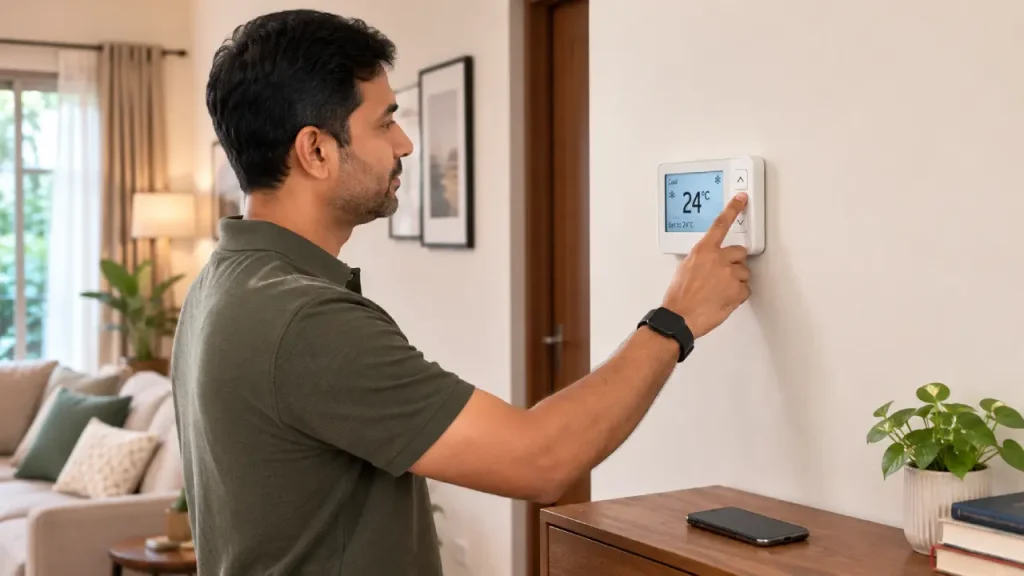
A smart thermostat without WiFi can still give you better temperature control, useful scheduling, and improved comfort without depending on a home internet connection. While many modern thermostats connect to WiFi and smartphone apps, not every household needs those features. In fact, some homeowners prefer a simpler setup that works locally and does not rely on cloud services. If you are upgrading from a traditional thermostat but do not want a complicated connected system, a non-WiFi model can offer a practical middle ground. In this guide, you will learn how these thermostats work, what features they offer, where they fit best, and what you should consider before buying one.
What Is a Smart Thermostat Without WiFi?
A smart thermostat without WiFi is a thermostat that provides advanced temperature-control features without requiring a WiFi connection. Instead of sending information through the internet, it normally uses built-in controls, sensors, programmed schedules, or other local communication methods.
That difference matters because the word “smart” does not always mean “internet-connected.”
For example, a basic programmable thermostat can automatically change the temperature according to a schedule. Some advanced models can also detect temperature changes, learn household patterns, or provide more precise control. Depending on the model, these functions can work locally.
So, look beyond the WiFi label when comparing thermostats. A thermostat can still offer useful automation even when it does not connect to your router.
How Does It Work?

The thermostat measures the temperature inside your home and compares it with your selected setting. Then, based on its programming and control logic, it tells your heating or cooling system when to operate.
For instance, imagine that you set your thermostat to 21°C during the evening. When the indoor temperature drops below your chosen range, the thermostat can signal the heating system to turn on. Once the room reaches the desired temperature, it can tell the system to stop.
As a result, the thermostat manages temperature automatically instead of requiring you to adjust it every few minutes.
Some models also support daily or weekly schedules. So, you might set a lower temperature while everyone is away and a more comfortable setting before people return home.
This simple automation can make a noticeable difference in convenience.
Why Choose a Smart Thermostat Without WiFi?
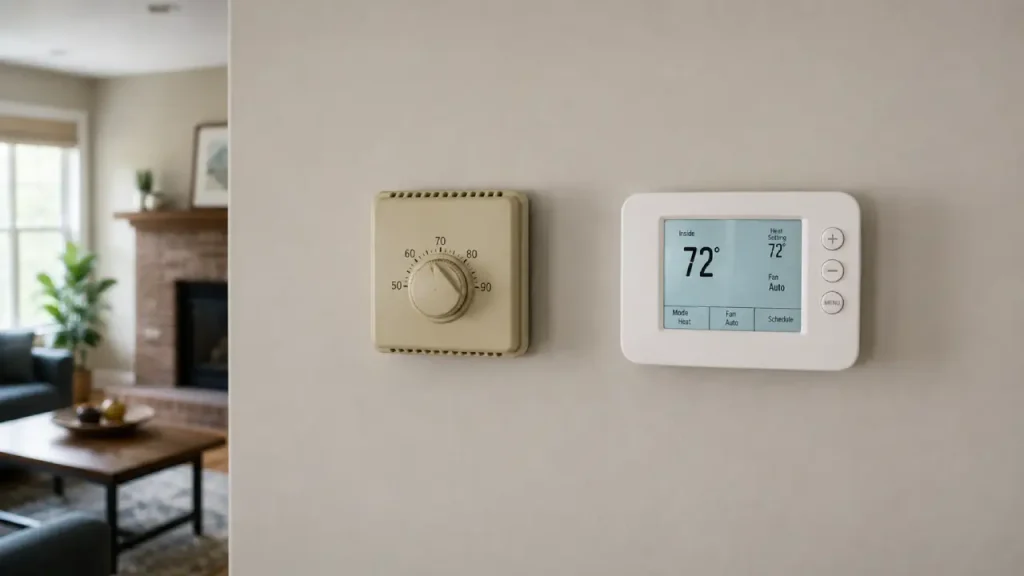
There are several reasons why homeowners may choose a thermostat that does not need internet access.
First, installation and setup can feel simpler. You do not have to connect the device to a wireless network or create an account with a manufacturer.
Second, local operation can provide peace of mind. If your internet connection goes down, the thermostat can continue following its programmed settings, depending on the model.
Furthermore, some people simply do not need remote temperature control. If you usually stay at home or follow a predictable routine, controlling your thermostat from a smartphone may not provide much extra value.
Another advantage involves privacy. WiFi-enabled thermostats may collect information related to usage, schedules, or connected devices. A locally operated thermostat generally has fewer internet-based functions to manage.
However, this does not mean every non-WiFi thermostat is automatically better. Instead, the right choice depends on your home, HVAC system, daily routine, and preferred features.
Smart Thermostat Without WiFi vs. WiFi Thermostat
The biggest difference between the two options is connectivity.
A WiFi thermostat can connect to the internet and often allows you to control your home’s temperature remotely through a smartphone application. Some models can also integrate with smart home platforms and voice assistants.
By comparison, a smart thermostat without WiFi usually focuses on local controls, schedules, sensors, and automatic temperature management.
| Feature | Non-WiFi Smart Thermostat | WiFi Smart Thermostat |
|---|---|---|
| Internet required | Usually no | Usually yes |
| Smartphone control | Usually unavailable | Common |
| Programmable schedules | Often available | Common |
| Remote access | Usually unavailable | Usually available |
| Local operation | Yes | Yes, depending on model |
| Smart home integration | Limited | Often available |
| Setup complexity | Usually simpler | Can be more involved |
| Dependence on internet | Low | Higher |
So, which one should you choose?
If remote access and smart-home integration matter to you, a WiFi thermostat may make more sense. On the other hand, if you mainly want automation and scheduling without internet dependence, a non-WiFi option may suit you better.
Smart Thermostat Without WiFi: Key Features to Look For
Not all thermostats without WiFi offer the same capabilities. Therefore, check the feature list carefully before making a purchase.
1. Programmable Scheduling
Scheduling is one of the most useful features to look for.
A programmable thermostat lets you create different temperature settings for different times of the day. For example, you can use one temperature during the morning, another while you are away, and a more comfortable setting in the evening.
Weekly scheduling can make this even more convenient because you can create separate patterns for weekdays and weekends.
As a result, you do not need to remember to change the temperature manually every morning.
2. Easy-to-Read Display
A clear display makes everyday operation easier.
Look for a screen that shows the current temperature, target temperature, operating mode, and other important information without making the interface unnecessarily complicated.
Large numbers can also help older adults or people who prefer quick visual information.
3. Temperature Sensors
Accurate temperature sensing is essential because the thermostat uses that information to decide when your HVAC system should operate.
Some advanced models may include additional sensors or occupancy-related features. However, available features vary significantly between products.
Therefore, do not assume that every thermostat includes the same type of sensor.
4. Heating and Cooling Compatibility
This point deserves special attention.
Before purchasing any thermostat, check whether it works with your HVAC system. Different homes may use central air conditioning, heat pumps, furnaces, boilers, or other equipment.
Additionally, some systems require specific wiring or power arrangements.
A thermostat with excellent features will not help if it cannot properly control your HVAC equipment.
5. Energy-Saving Scheduling
A good schedule can help reduce unnecessary heating or cooling.
For example, you may not need the same indoor temperature when everyone is sleeping or away from home. By adjusting the schedule around your routine, you can avoid running the HVAC system more than necessary.
However, scheduling alone does not guarantee a specific amount of savings. Your climate, insulation, HVAC efficiency, home size, and temperature preferences all influence energy use.
How It Can Help With Energy Efficiency
One common misconception is that only internet-connected thermostats can save energy.
That is not true.
A thermostat can reduce unnecessary HVAC operation simply by following a well-designed schedule. For example, you could set a moderate temperature during working hours and return to a comfortable setting before the household becomes active again.
Similarly, you can use different settings during sleeping hours.
The key is to avoid constantly heating or cooling an empty home.
Moreover, precise temperature control can help maintain a more consistent indoor environment. Instead of frequently making manual adjustments, you allow the thermostat to manage the system according to your planned settings.
Still, remember that a thermostat is only one part of household energy efficiency. Insulation, windows, air leaks, HVAC maintenance, and equipment efficiency also play major roles.
Is a Non-WiFi Thermostat Actually Smart?
This question often creates confusion.
The answer depends on how you define “smart.”
If you expect smartphone control, cloud connectivity, voice commands, and remote access, then a non-WiFi thermostat may seem less smart.
However, if you define smart functionality as automation, scheduling, temperature sensing, and automatic HVAC control, then many non-WiFi models can still provide useful smart features.
Think about a washing machine. It can automatically choose a wash cycle without connecting to the internet. Similarly, a thermostat can make automatic decisions without communicating with an online server.
Therefore, connectivity and intelligence are not the same thing.
Who Should Consider a Non-WiFi Thermostat?
This type of thermostat can work particularly well for people who prefer simple technology.
For example, it may suit homeowners who:
- Follow a regular daily routine.
- Do not need smartphone temperature control.
- Want programmable temperature schedules.
- Prefer local controls.
- Have unreliable internet service.
- Want fewer connected devices in their home.
- Prefer a simpler thermostat interface.
- Want to upgrade from a basic manual thermostat.
It can also work well in certain rental properties or homes where the owner wants programmable temperature control without adding another internet-connected device.
Nevertheless, you should always check HVAC compatibility before choosing a model.
What You Give Up Without WiFi
Choosing a non-WiFi thermostat also means giving up some features.
The most obvious limitation is remote access.
With a connected thermostat, you might be able to change your home’s temperature while sitting at work, traveling, or relaxing somewhere else. A non-WiFi model generally cannot provide that internet-based control.
You may also lose integrations with voice assistants and broader smart-home ecosystems.
For some homeowners, that will not matter. For others, it could become frustrating.
Additionally, WiFi models may offer more advanced reporting, app-based scheduling, notifications, software updates, and other connected features.
Therefore, think about how you actually use your home rather than choosing a thermostat based only on the word “smart.”
Installation Considerations
Installing a thermostat may look simple, but wiring can become complicated depending on the HVAC system.
Before removing your existing thermostat, identify the wiring and check the manufacturer’s compatibility information for the replacement.
Common thermostat wiring labels can include terminals such as R, C, Y, G, W, and O/B. However, wiring configurations vary, especially with heat pumps and specialized systems.
For that reason, never assume that matching wire colors alone is enough.
If you are unsure about your system, a qualified HVAC professional can check the wiring and compatibility.
Also, some thermostats need a common wire, often called a C-wire, while others use different power arrangements. The exact requirement depends on the model and HVAC setup.
Taking a few minutes to verify these details can prevent installation problems later.
How to Set Up a Useful Temperature Schedule
Once you install the thermostat, the next step involves creating a practical schedule.
Start by thinking about your real routine.
Ask yourself when people wake up, leave home, return, and go to sleep. Then build your temperature settings around those periods.
For example, you might use a comfortable setting during your morning routine, a more moderate setting while the house is empty, and another comfortable setting during the evening.
However, avoid making dramatic temperature changes simply because you think bigger adjustments always produce bigger savings.
Instead, choose settings that balance comfort and efficiency.
After a few days, review how the schedule feels. If the home becomes uncomfortable before someone arrives, adjust the timing. Likewise, if the HVAC system runs more than expected, reconsider the temperature range.
A good schedule should fit your lifestyle rather than force your lifestyle to fit the thermostat.
Common Mistakes to Avoid
Choosing and using a thermostat becomes easier when you know what mistakes to avoid.
Ignoring HVAC Compatibility
This is one of the biggest mistakes.
Do not purchase a thermostat based only on appearance or features. Check whether it supports your heating and cooling equipment first.
Expecting Smartphone Control
A non-Wi-Fi model generally cannot provide internet-based remote control. If you want to change the temperature from another location, verify that feature before purchasing.
Creating an Unrealistic Schedule
A complicated schedule may look efficient on paper but become annoying in real life.
Keep your schedule practical and adjust it when your routine changes.
Focusing Only on the Thermostat
A thermostat cannot fix every energy-efficiency problem.
If your home has poor insulation, air leaks, dirty filters, or an inefficient HVAC system, those issues may have a much larger effect on energy use.
Skipping Professional Help When Needed
If the wiring looks unfamiliar or your HVAC system has unusual requirements, professional assistance can save time and prevent costly mistakes.
Smart Thermostat Without WiFi: Is It Worth It?
For many households, a smart thermostat without WiFi technology can provide a useful balance between automation and simplicity.
It can offer programmable schedules, automatic temperature control, and convenient local operation without requiring a constant internet connection.
However, whether it is worth buying depends on what you expect from your thermostat.
If your main goal involves scheduled temperature control and easier daily management, it can be an excellent choice.
On the other hand, if you travel frequently, want remote access, use voice assistants, or have a connected smart-home ecosystem, you may prefer a WiFi-enabled model.
In other words, “smart” does not automatically mean “better.” The best thermostat is the one that matches your needs.
Final Thoughts
A smart thermostat without WiFi can be a practical option for homeowners who want more control without adding another internet-connected device to their home. With features such as programmable schedules, temperature sensing, and automatic HVAC control, these thermostats can offer much more convenience than traditional manual models.
At the same time, they have clear limitations. You generally will not get smartphone control, remote access, or extensive smart-home integration. Therefore, your decision should depend on your daily routine, HVAC system, comfort preferences, and expectations.
Most importantly, do not choose a thermostat simply because it has a long feature list. Instead, focus on compatibility, ease of use, scheduling options, temperature accuracy, and the way you actually live.